Thought Leadership
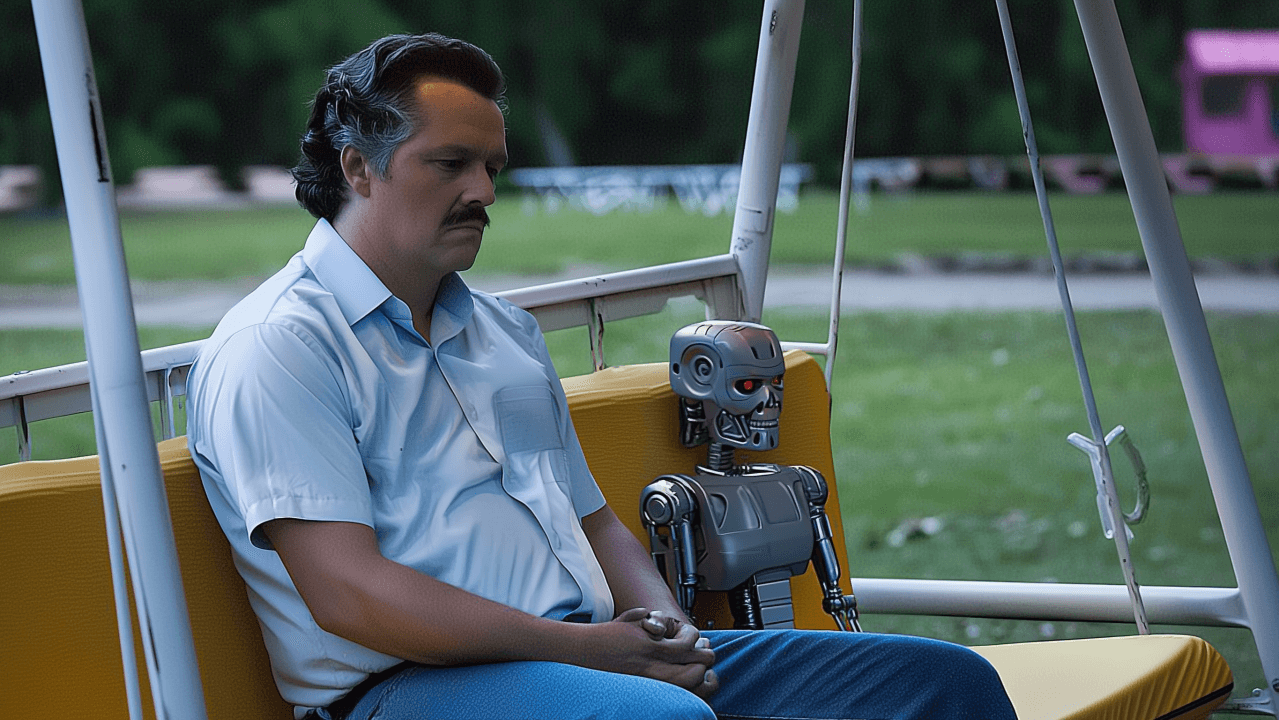
Listen to industry buzz lately, and you'd think we're moments away from Skynet flipping the switch on creative studios everywhere. According to these doomsday prophets, AI will soon Terminator-walk into your office to enact the wholesale replacement of human designers and artists. But the future isn't an apocalypse — it's just another sequel. And like all good sequels, the plot thickens, things get complicated, and hopefully, the special effects improve.
In my day-to-day life at Signal Factory, we're elbow-deep with ambitious brands, wrestling cutting-edge tech, and occasionally spilling coffee on very expensive equipment. All that hands-on chaos gives us a front-row seat to exactly how AI is shaking up not just the tools of the trade — but why we even bother creating in the first place. Class, take out your (physical) books and turn to the first chapter.
Fast Food vs. Fine Dining
AI is about to accelerate the creative industry's already brewing civil war into two distinct factions:
1. Low-Tier, Automated Content
This tier is basically the Canva Cinematic Universe — fast, accessible, and thoroughly "fine" (you know, the Marvel of creative tools). Everyday users and small businesses will eagerly embrace AI's ability to spit out "good enough" content with just a click, and without the friction or expense traditionally involved. No Emmys or Golden Lions here — just straightforward, quick hits. It's like getting takeout pizza; not spectacular, but always there when you're hungry at 2 AM and no one is looking.
2. High-Tier, Brand-Level Creativity
Larger, more visible brands require a different caliber of creative output. This is the big-budget Christopher Nolan epic of creative content. Here, human insight, strategic thinking, and complex nuanced creativity are irreplaceable. AI won't replace these skills; instead, it will amplify them. AI-driven tools will empower creatives, enabling faster iterations, more agile production processes, and a deeper exploration of creative possibilities, all while still keeping the human component white-knuckled behind the wheel.
Robots Can't Dream
For all its hype, AI lacks one critical ingredient: inspiration. Human creativity is driven by inspiration — an inherently emotional, experiential, and nonlinear process. It involves the complex interplay of memories, emotions, random thoughts, and sensory experiences. These elements are uniquely human and deeply personal.
AI, on the other hand, is inherently regurgitative. It's DJ Roomba with a Spotify playlist full of humanity's greatest hits. It can synthesize this existing data, recombining ideas in novel but derivative ways. It can analyze patterns, predict outcomes, and combine existing ideas in fascinating ways, but it can't suddenly invent jazz or accidentally stumble onto the Beatles. AI is excellent at pattern recognition, but it doesn't spontaneously weep when a Sarah McLachlan song fires up in any of the Toy Story flicks.
Humans, though? We're unpredictable meatbags of emotion and randomness. Our brains are chaotic mood boards of memories, song lyrics, embarrassing high school moments, and hilarious memes we regret liking. Inspiration hits us unpredictably — usually in the shower, often at 3 AM, always inconveniently. Original ideas are not data, they exist at the organic and cellular level.
Creativity Needs Chaos
Here's our unfair advantage: we're emotional messes. What truly separates humans from machines is our lived experience. We laugh at sarcasm, cry at Pixar shorts, and cringe at awkward Zoom calls. AI can read every joke ever written, but it doesn't "get" why The Office is painfully hilarious or why "I am Groot" somehow captures an emotional spectrum. It has analyzed billions of interactions, yet it has never once genuinely laughed at a dad joke. Humor, empathy, irony, passion, vulnerability — these are distinctly human traits that no algorithm can authentically replicate. While AI aggregates generations of human-produced content, it lacks the experiential depth required to authentically generate these qualities anew.
These messy emotional truths drive the need for genuine connections in a way no algorithm can authentically replicate. It's our lived experiences, emotional depth, and bizarre unpredictability that give human creativity an irreplaceable edge. Flaws and all.
The Revolution Will Be Humanized
Understanding this distinction matters profoundly. Studios that recognize AI's role as collaborator rather than replacement (and take the appropriate steps along the way) will flourish. Those who view AI fearfully or dismissively risk missing profound opportunities, and potentially their own future.
At Signal Factory (and I hope for you), our north star is clear: AI is the gas poured on our own inherent human-creative fire — not our replacement. Embracing this perspective isn't just optimistic; it's strategically required for navigating whatever the future holds successfully.
In short, the future will belong to studios brave enough to let machines handle perfection — so humans can chase the beautifully imperfect, messy art of being unforgettable.
Frequently Asked Questions
Will AI replace human creatives and designers?
No — the piece argues AI is splitting creative work into two tiers rather than eliminating either one. Low-tier, automated content will increasingly be handled by AI for everyday and small-business use, while high-tier, brand-level creative work will continue to depend on human insight and strategic thinking, with AI acting as an amplifier rather than a substitute.
What's the difference between AI-generated content and human-led creative work, according to this perspective?
AI is described as fundamentally regurgitative — it recombines existing patterns and data in novel but derivative ways. Human creativity, by contrast, is driven by inspiration: an emotional, experiential, and nonlinear process shaped by lived memory, humor, and unpredictability that AI has no access to.
How should creative studios approach AI instead of fearing it?
The recommended approach is treating AI as a collaborator, not a replacement — using it to speed up iteration and production while keeping human judgment and creative direction in the driver's seat. Studios that adopt this view are positioned to benefit from AI; those that dismiss or fear it risk falling behind.

Kyle Stauffer
,
Co-Founder + Chief Creative Officer at Signal Factory
A rare combination of skills, Kyle’s “do it all” attitude is the foundation of Signal Factory. His leadership in video, animation and more is unmatched. Through his big brand experience, Signal Factory has become a globally sought-after creative group.